
Morocco still has a working craft economy rather than a heritage display. In Fes and Marrakech the souks are organised by trade because those trades are still practised there — the tanners, the brass-beaters, the weavers and the tile-cutters are doing the job, not performing it. Knowing what you are watching, and what separates the real thing from the copy, changes both what you see and what you take home.
Zellige: cut tile mosaic
Zellige is the geometric tilework on fountains, floors and walls throughout Morocco. It looks like mosaic but is made in the opposite way: glazed tiles are fired first, then each individual piece is chipped by hand into shape with a sharp hammer, working from memory rather than a template.
The craftsman is called a maallem. Training takes years, and the skill lies in cutting hundreds of identical small shapes so precisely that they lock together without visible gaps.
Modern printed tiles imitate the look at a fraction of the price. The tell is the surface: real zellige has slight variation in glaze colour and depth between pieces, and the joints are extremely fine. Printed tile is flat, perfectly uniform and repeats.
The Bou Inania and Attarine madrasas in Fes and the Bahia Palace in Marrakech are where to look at the finest examples.
Tadelakt: polished lime plaster
Tadelakt is the seamless, faintly waxy plaster used in hammams and increasingly in riad bathrooms. It is lime plaster applied in layers, compressed with a smooth stone, then sealed with black olive soap, which reacts with the lime to make it water-resistant.
It has no joints, which is why it works in wet rooms, and the polishing gives it a soft depth that paint cannot reproduce.
Marrakech is the traditional centre. If you stay in a riad with a tadelakt bathroom, the slightly uneven, hand-pressed surface is the point rather than a defect.
Leather and the Fes tanneries
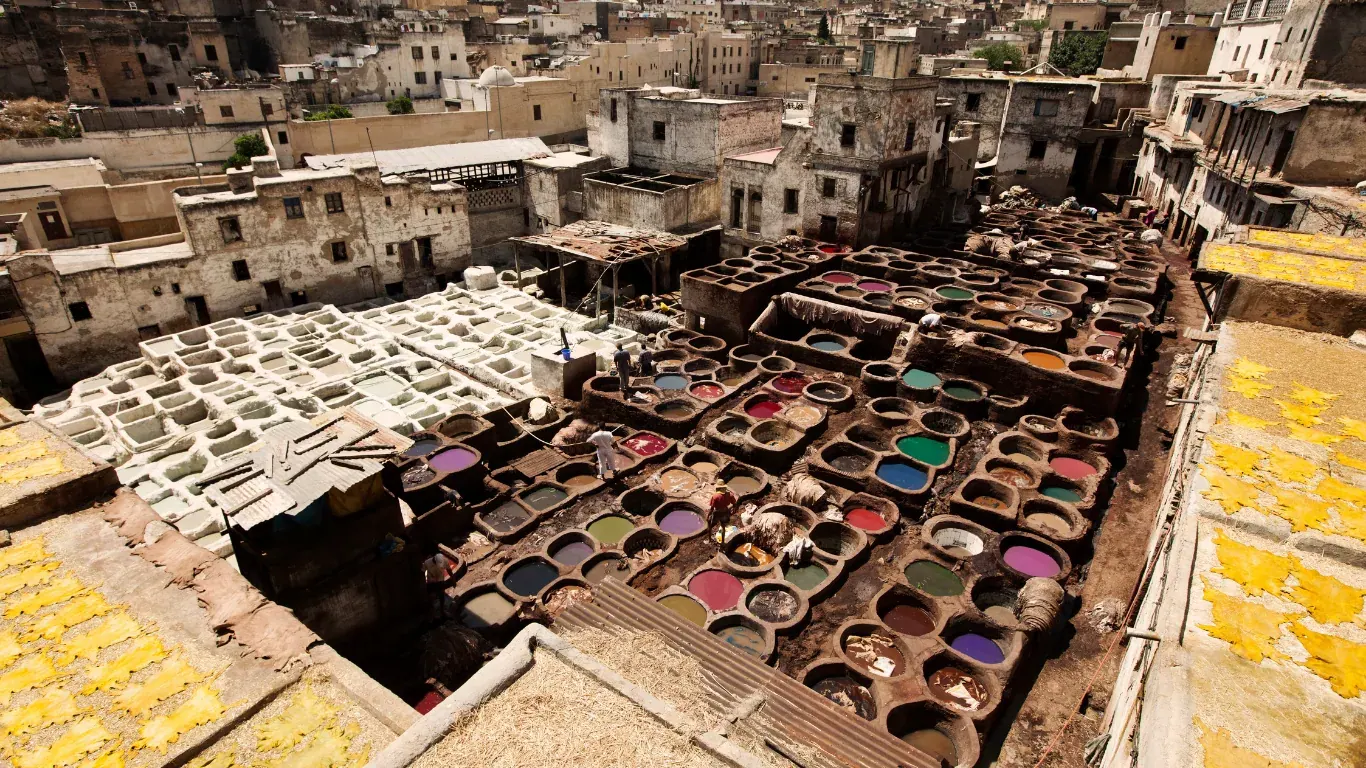
The Chouara tannery in Fes has been working the same way since the medieval period. Hides are soaked in lime and pigeon droppings to soften and strip them, then moved to dye pits coloured with poppy, indigo, saffron and mint.
The viewing terraces above the pits are attached to leather shops, and you will be handed mint to hold against the smell. There is no charge to look, though a tip is expected, and you will be shown goods afterwards.
Judging leather: real Moroccan goatskin is supple and smells of leather rather than chemicals, and the grain is irregular. Stitching should be even and tight. Babouches — the pointed slippers — should have a sole stitched rather than glued.
The strong chemical smell some visitors notice on cheaper goods is from the dye, and it does not fade quickly.
Carpets and what the names mean
Beni Ourain are the thick cream wool rugs with simple dark diamond patterns, made by Berber groups in the Middle Atlas. They were originally sleeping blankets for cold mountain winters, which is why the pile is deep.
Azilal rugs come from the High Atlas and are more colourful and freer in design, often narrative rather than geometric.
Boucherouite are rag rugs, woven from recycled fabric rather than wool. They are the least expensive and frequently the most striking.
Kilims are flat-woven with no pile — lighter, cheaper to ship, and generally more practical to get home.
Test wool by pulling a few fibres and burning them if the seller allows: wool smells of burnt hair and self-extinguishes; synthetic melts into a hard bead. Also turn the rug over. Hand-knotted rugs show the pattern clearly on the back; machine-made ones have a stiff backing that hides it.
Pottery: Fes blue and Safi green
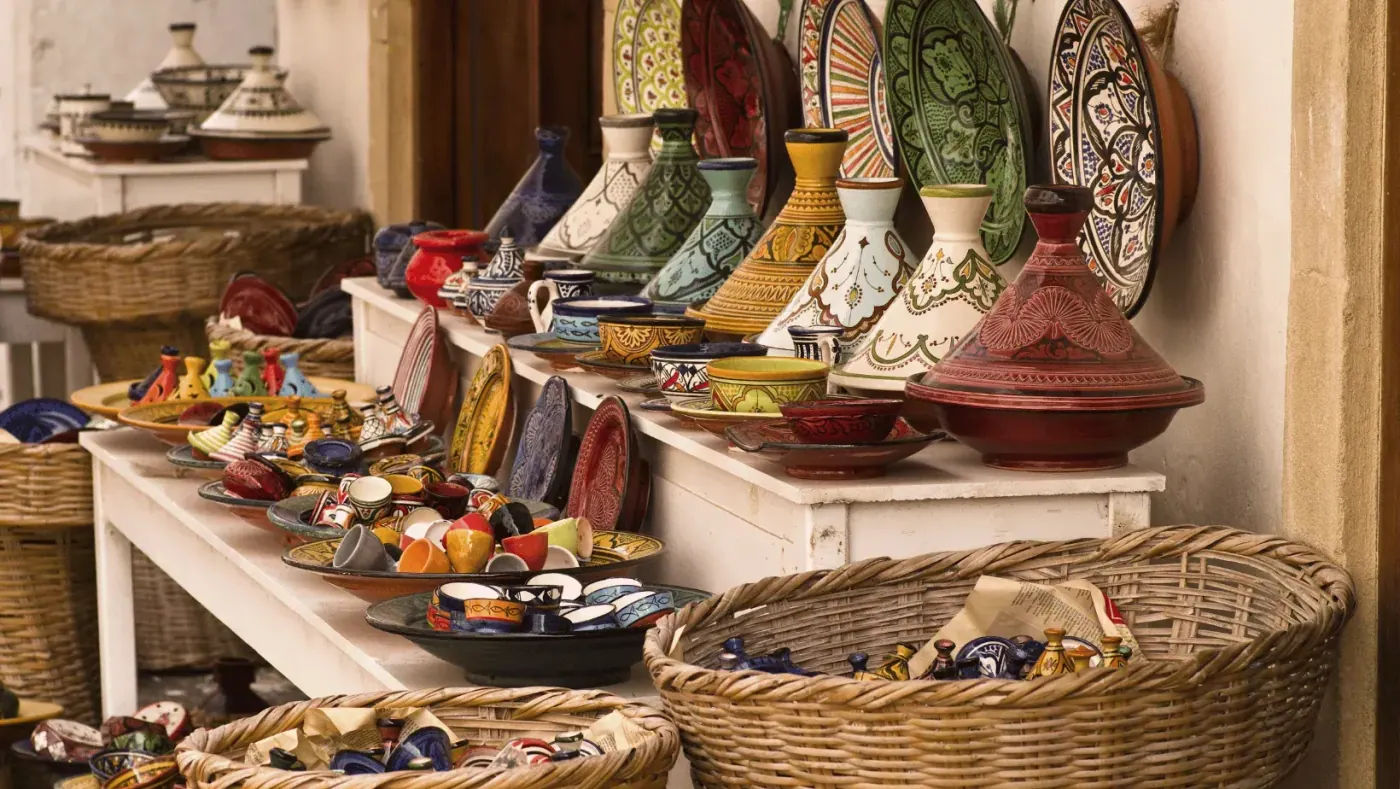
Fes pottery is traditionally cobalt blue on white, hand-painted, often with zellige-influenced geometry. The blue was historically expensive and remains the city’s signature.
Safi, on the Atlantic coast, is the other major centre, known for green glazes and a heavier, more rustic style.
Tamegroute in the south makes a distinctive green-glazed earthenware from local clay, fired in wood kilns, with a rough, uneven finish that collectors specifically look for.
Hand-painted pieces show brush variation and small asymmetries. Transfer-printed pieces are identical to each other and the line weight never varies.
Metalwork, wood and silver
Brass and copper are worked in the Marrakech souks and around Place Seffarine in Fes, where the noise of hammering is constant. Lanterns, trays and teapots are the staples. Hand-beaten pieces show fine hammer marks; spun ones are perfectly smooth.
Thuya wood comes from the area around Essaouira, where the burl of the tree produces a dense, fragrant, heavily figured grain used for boxes and inlay. It is genuinely local and slow-growing, which is why good pieces are not cheap.
Cedar from the Middle Atlas is the carving wood, used for doors, ceilings and screens. The scent alone identifies it.
Tiznit in the south is the silver town, associated with Berber jewellery — heavy, geometric, often set with amber, coral or enamel. Ask about silver content; "Berber silver" is sometimes an alloy with very little silver in it.
Where each craft is best seen
Fes: leather, zellige, brass, blue pottery, and the highest concentration of skilled workshops in the country. Fes el-Bali is where to spend the time.
Marrakech: brass, lanterns, leather goods, carpets and the widest selection, though prices reflect the visitor volume.
Essaouira: thuya wood, and a calmer place to buy than either big medina.
Tiznit and the south: silver and Berber jewellery. Safi and Tamegroute: pottery. The Middle Atlas villages: carpets, bought closer to the source.
Buying without being taken advantage of
Understand the commission system. Guides and drivers often receive a percentage from shops they bring you to, which is normal and does not make the goods bad — but it does raise the price. Ask directly whether a stop is commission-based, and feel free to decline it.
Negotiate as a conversation rather than a contest. Start well below the asking price, move slowly, stay friendly, and be genuinely willing to walk away. Walking away is the only real leverage you have.
Buy the thing you like rather than the investment. Almost nothing sold to visitors is an antique, whatever the story attached to it.
For carpets, check shipping before you commit. Reputable dealers arrange it and provide paperwork; a kilim is far easier to carry home than a thick Beni Ourain.
Watching things being made
The workshops are not closed to visitors. Tanneries, brass workshops and pottery cooperatives generally welcome people watching, and in Fes you can stand at the edge of the Seffarine and simply observe.
A cooperative is usually a better place to buy than a shop, because more of the money reaches the maker. Women’s argan cooperatives in the Souss and weaving cooperatives in the Atlas both operate on this basis.
If you want to see craft properly rather than shop for it, ask your guide for the workshop rather than the showroom. Most are happy to arrange it, and it is the more interesting half of the day.
The apprenticeship system
Moroccan craft still runs on a workshop apprenticeship rather than a school. A boy — and increasingly a girl, in the weaving and argan cooperatives — joins a maallem’s workshop young and progresses by doing, over years, in a hierarchy that is visible the moment you walk into a brass workshop.
This is why the quality gap between pieces is so wide. Two objects side by side in the same souk may be the work of a master with thirty years behind him and an apprentice in his second, and the price will not always tell you which is which.
It is also why the crafts are fragile. Apprenticeships are long and poorly paid relative to other work, and several trades have far fewer young entrants than they did a generation ago. Buying from cooperatives and workshops rather than resellers is the most direct way a visitor supports the system continuing.
Getting it home
Small items travel fine in hand luggage. Ceramics need more care than people expect — glazed pottery chips easily and Moroccan packing is usually newspaper and optimism. Ask for it to be wrapped properly and pack it in the middle of a soft bag.
Carpets are the significant decision. A kilim folds into a suitcase; a thick Beni Ourain does not. Established dealers ship internationally and will provide paperwork and a tracking number — ask for both before paying, and pay by a method that gives you recourse.
Check your own customs rules before buying anything containing animal products, and be aware that genuine antiques over a certain age require an export licence from the Ministry of Culture. Almost nothing sold to visitors falls into that category, whatever the seller says about its age.
Argan oil and spices are fine to bring back into most countries in reasonable quantities, but liquids over 100ml must go in checked luggage.
Frequently asked questions
Zellige tile mosaic, leather from the Fes tanneries, hand-knotted Berber carpets, brass and copper work, blue Fes pottery, thuya woodwork from Essaouira and silver jewellery from Tiznit.
Geometric mosaic made by firing glazed tiles first and then chipping each piece into shape by hand. Real zellige has slight glaze variation between pieces and extremely fine joints; printed imitations are perfectly uniform.
Turn it over. A hand-knotted rug shows the pattern clearly on the reverse; machine-made rugs have a stiff backing that obscures it. Wool fibres smell of burnt hair when singed, synthetics melt into a hard bead.
Not necessarily, but many are commission-based, which raises the price. They should be optional and disclosed. Ask before you set off, and feel free to decline.
Fes for the highest concentration of skilled workshops, Marrakech for selection, Essaouira for thuya wood and a calmer experience, and cooperatives anywhere for more of the money reaching the maker.
Yes. Tanneries, brass workshops and pottery cooperatives generally welcome visitors. Ask your guide for the workshop rather than the showroom.